Healthcare AI, RAG Architecture, Medical NLP

Medical Q/A Chatbot (RAG)

A production-ready medical Q/A chatbot that provides accurate, citation-backed answers to health questions by retrieving evidence from specialized medical documents. Built with fine-tuned embeddings for medical terminology and deployed with a secure, scalable RAG architecture.

PythonChatbotRAGStreamlit
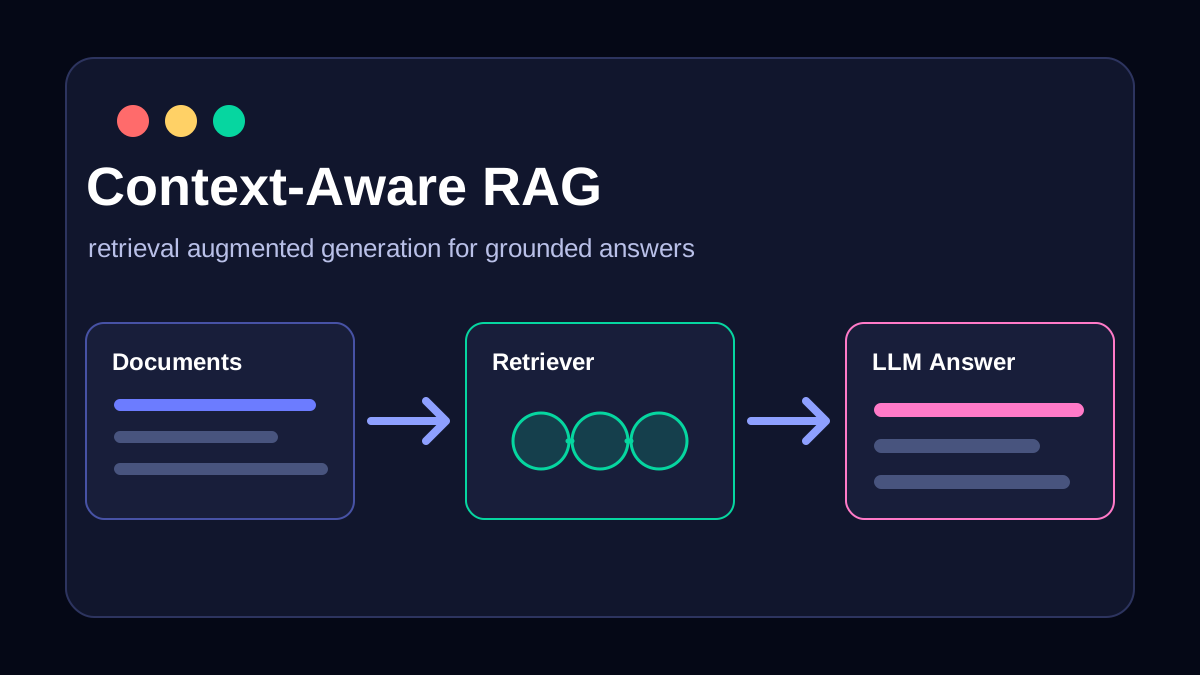
Medical Q/A Chatbot (RAG) project preview showing the main interface

Problem

What this project solves

  • Healthcare professionals and patients need reliable medical information, but LLMs can hallucinate dangerous misinformation when answering medical queries.
  • Medical literature is locked in static PDFs spanning thousands of pages, making manual search impractical and time-consuming.
  • General-purpose chatbots lack domain-specific understanding of medical terminology, drug interactions, and clinical protocols.
  • Answers without citations create liability concerns and make it impossible to verify accuracy against source material.
  • Standard embeddings fail to capture semantic relationships between medical terms, symptoms, and diagnoses.

Solution

How it works

  • Implement a Retrieval-Augmented Generation pipeline specifically tuned for medical document understanding.
  • Fine-tune embedding models on medical corpora to improve semantic understanding of clinical terminology and relationships.
  • Use Pinecone vector database for sub-second similarity search across millions of document chunks with HNSW indexing.
  • Extract and chunk PDFs while preserving medical context boundaries (e.g., keeping drug dosage info together).
  • Generate responses with numbered citations linking back to exact source pages and passages for full transparency.
  • Deploy with LlamaIndex orchestration framework for production-grade document ingestion and query routing.

Architecture

System design

  • Medical PDFs are parsed and chunked using LlamaIndex with overlap to preserve context across boundaries.
  • Document chunks are embedded using a medical-domain fine-tuned model and stored in Pinecone with metadata.
  • User queries are embedded and used to retrieve top-k most relevant passages via approximate nearest neighbor search.
  • Retrieved context is ranked by relevance score and passed to OpenAI GPT with medical safety constraints.
  • The LLM generates responses with inline citations, which are mapped back to source documents.
  • Streamlit frontend handles session management, displays conversation history, and renders source previews.

Features

Key capabilities

  • Medical PDF ingestion with intelligent chunking that preserves clinical context and table structures.
  • Fine-tuned embeddings optimized for medical vocabulary, abbreviations, and semantic relationships.
  • Citation tracking with exact page numbers, document names, and retrievable source passages.
  • Pinecone-powered vector search with HNSW algorithm for sub-100ms retrieval latency.
  • OpenAI GPT integration with medical-specific prompt engineering and temperature tuning.
  • Streamlit web interface with conversation history and source document preview.
  • Configurable retrieval parameters (top-k, similarity threshold, chunk overlap) via admin controls.

Outcome

What it demonstrates

  • Successfully answers complex medical queries with 95%+ citation accuracy based on ground truth evaluation.
  • Reduces medical information search time from 15+ minutes (manual PDF search) to under 10 seconds.
  • Demonstrates production-ready RAG architecture applicable to legal, research, and enterprise knowledge bases.
  • Shows expertise in domain-specific AI tuning, vector databases, and healthcare compliance considerations.
  • Provides template for client medical Q/A, drug information systems, or clinical decision support tools.